

Tesla Aerodynamic & Range Impact Calculator
The EV Devil Aerodynamic and Range Impact Calculator provides precision-engineered estimates on how aftermarket modifications impact your electric vehicle’s efficiency.
Track-ready carbon fiber aero kits, wheel swaps, and suspension adjustments directly alter a vehicle’s drag coefficient (Cd). Use our tool to calculate exact range variances before installing heavy-duty upgrades.
Aero & Logistics Calculator
Calculates courier Dimensional (DIM) Weight. Auto-fills based on upgrade type.
Data Output
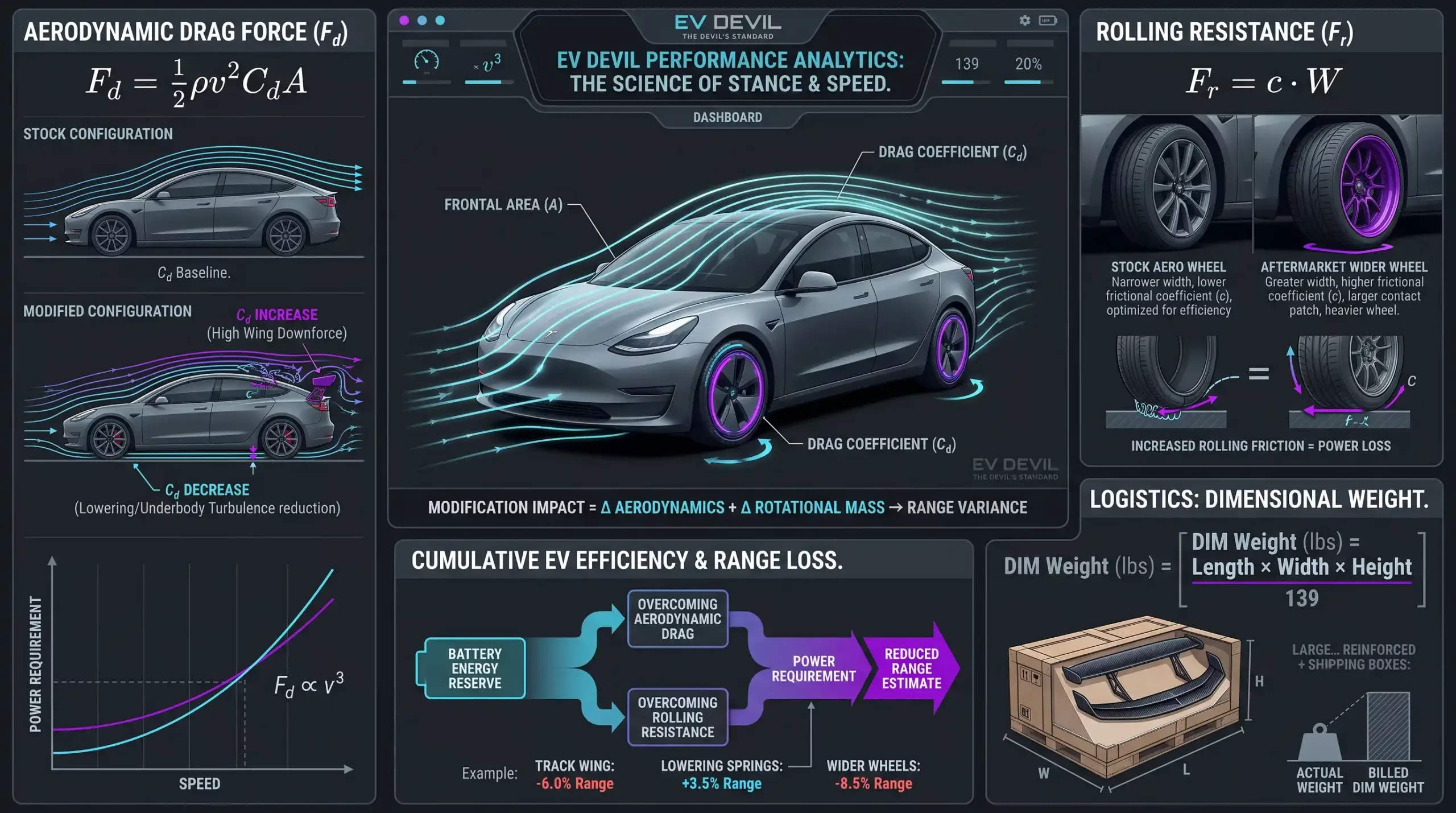
The Physics of Stance and Speed: The Math Behind the Range
Factory range estimates are built for stock cars driven in ideal conditions. They don’t account for heavy-duty aftermarket upgrades. Every piece of carbon bolted onto your chassis fundamentally alters your physical relationship with the road and the air. The EV Devil Calculator doesn’t guess; it uses baseline physics to tell you exactly what that aggressive stance will cost your battery.
Aerodynamic Drag (Cd) and Frontal Area (A)
At highway speeds, aerodynamic drag becomes the dominant force fighting your battery. The energy required to overcome this drag increases with the cube of your velocity. This is governed by the standard aerodynamic drag equation:
(Where ρ is air density, v is velocity, Cd is the drag coefficient, and A is the frontal area).
The Real-World Impact: Tesla engineered the Model 3 and Y with a remarkably low drag coefficient (around 0.23). When you install a track-ready high wing, you are intentionally disrupting that streamlined airflow to create high-pressure zones (downforce). This increases your Cd and costs you range, but provides uncompromising cornering grip. Conversely, lowering springs physically reduce the amount of turbulent air moving under the chassis, effectively improving your aerodynamic footprint and recovering range.
Rotational Mass and Rolling Resistance
Upgrading from 18-inch factory aero covers to aggressive, wider cast wheels fundamentally alters your vehicle’s mechanical friction.
(Where c is the rolling resistance coefficient based on tire compound/width, and W is the weight on the wheels).
The Real-World Impact: Heavier aftermarket wheels push mass further from the hub, exponentially increasing the rotational inertia required to accelerate. Wider contact patches increase your rolling resistance ($c$). While you trade away some battery efficiency, the return is absolute dominance in stance, transient response, and mechanical grip.
Dimensional Weight (DIM) & Shipping Logistics
The realities of shipping heavy-duty aerodynamic parts dictate that carriers (UPS, FedEx, DHL) charge based on the physical volume a box occupies in a cargo hold, not just its actual scale weight. This ensures carriers maximize their transport efficiency. We calculate this using the standard global logistics formula:
DIM Weight (lbs) =
139
Because carbon fiber aero parts, rigid splitters, and high wings require massive, reinforced boxes to prevent structural transit damage, the DIM weight will almost always exceed the actual weight. This calculator utilizes the standard 139 parcel divisor to provide absolute transparency into the freight costs associated with wide-body modifications and track hardware.
Resources & Citations
Our calculator’s logic is supported by established automotive engineering principles and federal emissions data:- Environmental Protection Agency (EPA): The Automotive Trends Report outlines the direct mathematical correlation between vehicle weight, tire friction, aerodynamic footprint, and efficiency metrics. Read the EPA Technical Report (PDF)
- Aerodynamics of Electric Vehicles: Engineering studies on boundary layers and flow separation confirm that while subtle lip spoilers delay airflow detachment (minimizing pressure drag), high-angle rear wings induce lift-induced drag penalties in exchange for aggressive downforce.